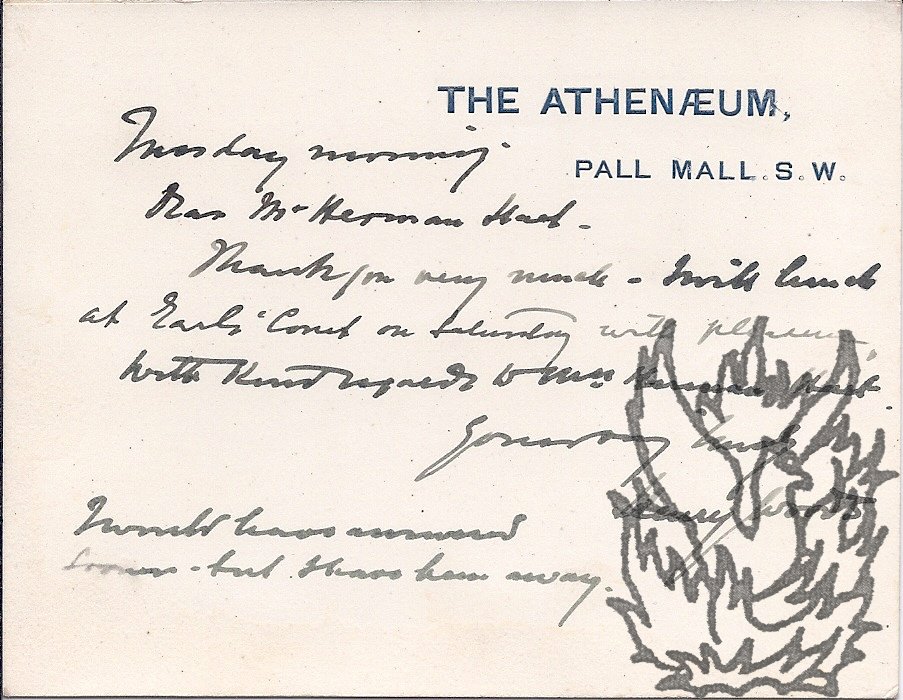
Ist Baron Glenesk, newspaper proprietor (1830-1908), 4pp., 8vo, stained but not obscuring text, giving his reason for not seeing Yates’s “representation”, and planning a pre-luncheon conversation about Napoleon, Palmerston and the like. He is pleased to be given a place in Yates’s “Gallery”.
Lord Houghton, poet and politician (1809-1885). 2pp., 8vo, damp-staining not obscuring text, inviting his correspondent and wife to the debate on the occupation of Cracow at the House of Commons, giving directions for a meeting afterwards.
Writer on natural history (1780-1868). One page, 8vo, good. He thanks his correspondent for his “interesting pamphlet” and discusses rough drawings of swans he is sending him.
(Peace Society (1893)). 2pp., 8vo, H.(?) Evans Darby to the Chevalier Dr Karl de Scherzer, He informs his correspondent that the last “universal Peace Congress” in Chicago decided to invite eminent jurists “to form a Committee for thepurpose of considering the question of an International Court of Arbitration”. As a member of the provisional committee, he has beenasked to prepare a list for this committee for Europe. He invites hiscorrespondent to join it (“I should not think that it would involve muchlabour or responsibility”).
Poet and journalist (1797-1864). 2pp., 8vo, good. Watts accepts an invitation and gives his excuse for not responding earlier in rather more words than appear necessary.
Novelist (1861-1955). 3pp. ea., 8vo, good. He cannot accept Bill’s invitation because he has arranged to play in a cricket match. He has been accumulating material for a book on Brittany(“By ‘serious’, I mean not a novel!), and reports on the success of The Face of Clay (published 1906).
Writer (1849-1923). 1 & 2pp., 8vo, good. In the former, he gives details of his movements in the expectation of a meeting. In the latter, he describes his plans and, when he has been able to “get at” his copies of his book, he will send him one.2 items,
Novelist, dramatist and journalist (1831-1894). One page each, 8vo, good. In the first, he is sorry that “Fred” has been bothered in a particular“matter”. In the second, he says simply “Here is the Valentine you askfor”.
Spanish author. Two pages, 4to. He writes concerning the World Unity Movement of which Polak is a sponsor, criticising the Chairman, James Avery Joyce. With: a TLS, 2pp., 4to, from Joyce to Polak referring to a note he has received from de Madariaga (copy enclosed) and describing his difficulties in finding a speaker. He also asks for his expenses from an American trip which de Madariaga found offensive.
Politician (1786-1863). One page, 4to, good, , damp-staining but text clearsaying that he will “defer the Borough meeting” and hope to meet hiscorrespondent at the Budge Hotel.
Founder of Toynbee Hall (1844-1913). 4 ALSs, 2pp. ea., 8vo,good, three to C.H. Grinling, socialist, , the fourth to “Trevelyan”. He describes a model of a curate, invites Grinling to a retreat of sorts,discusses a conversation he had had with Ramsay Macdonald on booksand workmen and how Macdonald wants to discuss the matter withothers.
Governor-General of India. 5 & 2pp., 8vo. Some illegible. (1830) he asks himself whether the "Board" should reply to "the Statements and Assumptions of the . . . Secret Committee in the subject of the Secret Letters relating to the Treaty with . . .(?)". He continues on the theme, concluding that ther documents in question had been perused by Lord Clare, the intended successor of Sir John Malcolm" (Governor of Bombay). (1841) he is trying to arrange a meeting.
Russian emigre (1914- ?). ANS, 8vo, to “Miss Bentley”, envelope present, postmarked 24 April 1958. He asks her to cash a cheque for him to save him time.
Canon of St Paul’s and wit (1771-1845). One page, 4to, good. some damage, slightly affecting the text, traces of mounting. Smith outlines his travel plans, including a visit to his correspondent. He continues, “We talk of nothing now but bombarding & it is supposed that Troy would have been under such a Cannonade have been taken in 15 or 20 minutes”.
Corsican-Russian diplomat (1764-1842). One page, 12m,, in French, some damage to one word, traces of mounting. He accepts an invitation in gracious terms.
2nd Earl Granville, statesman (1815-1891). One page, 8vo, small portion cut out (place name prob.), ow. good. He claims a prior engagement, presumably after receiving an invitation, and hopes Clarendon is not tired after a long journey.
Social reformer, founder of Hampstead Garden Suburb (1851-1936)(DNB).ANS, on a scrap of packing paper, saying “Given to Ernest Aves[?] inever grateful memory of all he did to and for me. June 17th-21st 1913.Henrietta Barnet”. Her husband, Samuel A. Barnet, has signed another part.
Statesman and man of letters (1838-1928). 3pp., 8vo, good. He and his wife are pleased that their son is happy (presumably at aboarding school). He then expresses his detestation of the sort of touristwho does not enter into the spirit of a place (in this instance, Venice).
French general (1815-1896). On visiting card, two sides, in French. He expresses regret at not being able to see or receive “Mr. Roumieu” inTouraine. He later describes himself as an old friend of England’s.
Banker and writer (1840-1930). 2pp., 8vo, good. He is asking friends to his home for “chat and supper”, including Bowen.He gives minute directions how to get to his house in Tufnell Park.
French politician (1755-1849). 2pp., 4to, sl. creased. In French with official stamp.He recommends to Persil’s attention a “M. Ducon”, lawyer and “sous-prefet”, describing his exemplary character and his achievements, and requesting an extension of his period in office.
Baron Taunton, statesman (1798-1869). 2pp., 4to, good. He has been sent some material relating to the Merchant Seamen’s Billand relates it to his own views on the matter.
Painter (1842-1921). 2 ANSs, 8vo, good. In the first letter, he says that he has rested and feels able to continue with the sittings. In the second, he asks if he can exhibit her portrait at the “Grosvenor”. 2 items,
Judge (1796-1880). One page, 8vo, good. He asks for an opinion on whether someone could procure a patent on the basis of some papers he is sending to him.
Irish author and editor (1800-1889). One page, 8vo, good. He is thanking his correspondent on behalf of his wife for his contributionof a “little picture . . . in aid of the governess asylum”.
British Museum ceramics expert. One page, 8vo, good. He passes comment on a blue and a yellow pot, dating them, and giving the countries of origin of the yellow pot.